Contacts
Info
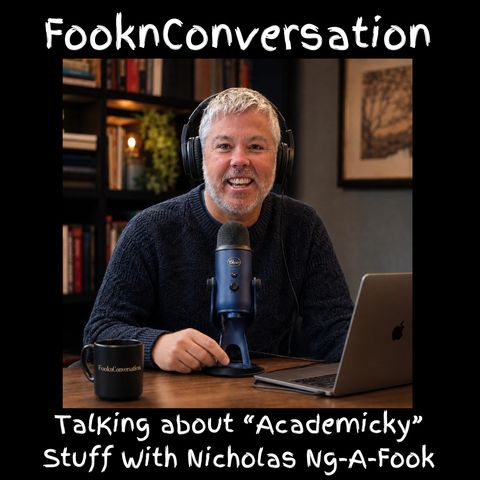
How are we talking about the “academicky” stuff that informs our lived experiences? In response to such questions, Dr. Nicholas Ng-A-Fook invites you to delve deeper into the lives and...
show more
How are we talking about the “academicky” stuff that informs our lived experiences? In response to such questions, Dr. Nicholas Ng-A-Fook invites you to delve deeper into the lives and thinking of different public intellectuals, writers, artists, community activists, politicians, school administrators, and teachers.
show less
Fookn Conversation - Talking About “Academicky” Stuff
Fookn Conversation - Talking About “Academicky” Stuff
voicEd RadioEpisodes & Posts
Episodes
Posts
11 OCT 2026 · In Episode 75, Dr. Nicholas Ng-A-Fook hosts https://www.uregina.ca/education/directory/faculty/spooner-marc.html, Professor in the https://www.uregina.ca/education/ at the https://www.uregina.ca/. His research examines https://journals.sagepub.com/doi/abs/10.1525/irqr.2015.8.2.212, academic freedom, the https://www.researchgate.net/profile/Marc-Spooner/publication/339971722_Critical_Pedagogy_Imperiled_as_Neoliberalism_Marketization_and_Audit_Culture_Become_the_Academy/links/5e70330b92851c1a689a6dbb/Critical-Pedagogy-Imperiled-as-Neoliberalism-Marketization-and-Audit-Culture-Become-the-Academy.pdf, social justice, activism, and participatory democracy. https://www.uregina.ca/education/directory/faculty/spooner-marc.html has published extensively across academic and public forums. He is co-editor, with https://uofrpress.ca/Contributors/M/McNinch-James, of the award-winning https://uofrpress.ca/Books/D/Dissident-Knowledge-in-Higher-Education (2018) and the recently published https://uofrpress.ca/Books/K/Knowledge-Under-Siege (2026), both published by https://uofrpress.ca/. Our conversation begins with https://www.uregina.ca/education/directory/faculty/spooner-marc.html’s formative experiences in teacher education, graduate studies, student governance, and political activism at the https://www.uottawa.ca/en, where he learned to connect critical theory with collective action. We discuss the role of universities in sustaining democratic societies, the importance of academic freedom, tenure, union advocacy, and community-engaged scholarship, and the growing pressures of chronic underfunding, performance-based funding, political intervention, and corporate managerialism. Drawing on https://www.cbc.ca/player/play/audio/9.7162060, we consider how universities have historically reproduced colonialism, exclusion, and institutional inequalities while also providing spaces for resistance, intellectual freedom, and social transformation. Dr. Spooner also reflects on the expanding influence of private consultants in reshaping higher education and the importance of Indigenous and decolonial knowledges, public engagement, and collective advocacy in imagining more equitable futures for universities. Throughout our conversation, we return to a central question: What are universities for, and how might we reimagine their responsibilities toward democracy, social justice, and the public good? Listeners can access the free, open-access PDF of https://uofrpress.ca/Books/K/Knowledge-Under-Siege through University of Regina Press and CBC Ideas podcast https://www.cbc.ca/player/play/audio/9.7162060.
3 SEP 2026 · In Episode 74, Dr. https://uniweb.uottawa.ca/members/653 hosts https://umanitoba.ca/education/lucy-delgado (she/they), https://ldelgado.com/and Associate Professor in the https://umanitoba.ca/education/ at the https://umanitoba.ca/. https://metisthinkers.com/about/lucy-delgado/is a Two-Spirit Métis woman, born and raised in Winnipeg, Manitoba, and a citizen of the Manitoba Métis Federation. Her family includes Sinclairs, Cummings, and Prudens, some of whom took scrip in St Andrews and St Johns, as well as family and ancestors from Red River, Oxford House, and Norway House, adopted family from Sioux Valley Dakota Nation, and settler family from Ireland and the Orkney Islands. Dr. Delgado is also a community organizer involved in local and national initiatives and is actively involved with the Two-Spirit Michif Local of the Manitoba Métis Federation. In this conversation, we discussed the importance of self-location in research, https://cjis.uwinnipeg.ca/index.php/CJIS/article/view/3, https://ices.library.ubc.ca/index.php/criticaled/article/view/186756, community connection, genealogy, racialization, https://pawaatamihk.uwinnipeg.ca/index.php/Pawaatamihk/article/view/134, and treaty relationships. Dr. Delgado also reflects on the creation of https://pawaatamihk.uwinnipeg.ca/index.php/Pawaatamihk, an open-access journal dedicated to uplifting the voices of Métis auntie scholars, artists, and community members, as well as https://www.mawachihitotaak.com/ and the development of https://cje-rce.ca/index.php/cje-rce/article/view/7485 scholarly https://metisthinkers.com/ that https://esj.usask.ca/index.php/esj/article/view/70878 for mentorship, relationship building, and knowledge mobilization.
20 AUG 2026 · In Episode 73, Dr. https://uniweb.uottawa.ca/members/653 hosts Dr. https://apps.ualberta.ca/directory/person/ddonald, Professor in the Faculty of Education at the https://www.ualberta.ca/en/index.html who holds a Canada Research Chair in https://www.unlearningcolonialism.ca/. His research focuses in part on the different ways Indigenous wisdom traditions can expand and enhance understandings of curriculum and pedagogy. His scholarship engages https://link.springer.com/content/pdf/10.1057/9781137008978.pdf#page=53, https://link.springer.com/chapter/10.1007/978-3-032-23483-4_12, and the ongoing effects of https://youtu.be/VM1J3evcEyQ?si=HarXOaB2YND6qPaf on educational thought and practice, while asking how educators might rethink relationships among Indigenous and non-Indigenous peoples through https://jcacs.journals.yorku.ca/index.php/jcacs/article/view/34405, https://www.edcan.ca/articles/a-curriculum-for-educating-differently/, https://youtu.be/97qwVDvGztE?si=GvC_Us7D6vwzR_f3, and https://jcacs.journals.yorku.ca/index.php/jcacs/article/view/40492. Recorded live during the annual https://csse-scee.ca/ conference at the https://www.uwinnipeg.ca/, this episode took place on https://treaty1.ca/ and the National Homeland of the https://www.mmf.mb.ca/the-red-river-metis-la-nouvelle-nation, in Wiiniibak, Manido Abi, ancestral lands of the Anishinaabeg, Anisininew, Ininiwak/Nehethowuk, Oceti Sakowin/Dakota Oyate, and Michif Peoples. Building on earlier conversation, they return to Dwayne’s evolving thinking about one’s standpoint, treaty sensibilities, kinship, and relational accountability. Drawing on his family history as a descendant of Treaty 6 signatories and his ancestor Jimmy Jock Bird, an interpreter and translator in Blackfoot homelands, Dwayne reframes treaty as a kinship covenant oriented toward love, responsibility, and cultivating more life-honouring forms of humanness.
20 MAY 2026 · In Episode 72, Dr. https://uniweb.uottawa.ca/members/653 hosts https://apps.ualberta.ca/directory/person/jamiles#Overview and https://matthewrkeynes.com/about/ to discuss their new co-authored book, https://www.bloomsbury.com/ca/education-and-historical-justice-9781350470231/. Drawing on comparative case studies from Canada, Australia, Northern Ireland, and South Africa, their scholarship examines how education systems, teachers, and students are increasingly being called upon to respond to histories of harm, violence, colonialism, and injustice within what they describe as an emerging “age of apology.” Our conversation explores difficult histories, truth and reconciliation, historical consciousness, collective responsibility, and the tensions surrounding historical justice education in liberal democratic settler states. https://apps.ualberta.ca/directory/person/jamiles#Overview and https://matthewrkeynes.com/about/ reflect on their respective journeys through history education research in Canada and Australia, their collaborative writing process during the COVID-19 pandemic, and the challenges of thinking beyond simplified narratives of guilt, empathy, and reconciliation. We also discuss contemporary struggles over curriculum politics, residential school denialism, public memory, redress, reparations, transitional justice, and the possibilities and limitations of history education in confronting misinformation, settler colonial violence, and democratic uncertainty.
12 MAY 2026 · In Episode 71, Dr. https://uniweb.uottawa.ca/members/653 hosts https://apps.ualberta.ca/directory/person/peck1, https://carlapeck.wordpress.com/ at the https://www.ualberta.ca/en/index.html and Director of https://thinking-historically.ca/, a national SSHRC-funded partnership focused on reimagining K–12 history education across Canada. https://apps.ualberta.ca/directory/person/peck1 https://carlapeck.wordpress.com/research/ explores how teachers and students understand history and democracy, with particular attention to how young people’s identities shape their historical consciousness, civic engagement, and sense of belonging within democratic life. Her https://carlapeck.wordpress.com/publications/ asks what it means for students to see themselves in history and why such questions matter within increasingly polarized social and political contexts. https://apps.ualberta.ca/directory/person/peck1 has authored and co-authored numerous articles and book chapters, and co-edited influential collections on difficult histories, global citizenship, and historical consciousness. Her most recent book, https://utppublishing.com/doi/10.3138/9781487543242, co-written with Dr. Alan Sears, argues for the urgent role history education can play in sustaining democracy in Canada and beyond. Our conversation explores curriculum policy politics, historical thinking, civic empathy, public advocacy, and actions public intellectuals can take up toward confronting misinformation, polarization, and democratic decline.
13 FEB 2026 · In Episode 70 Dr. https://uniweb.uottawa.ca/members/653 hosts https://staffprofile.unisq.edu.au/Profile/Aaron-Teo is a Singaporean Chinese first generation migrant settler living on unceded Jagera and Turrbal lands. He currently works as a sociologist of education at the University of Southern Queensland. Our conversation centers on his research into the racialized and gendered subjectivities of migrant teachers and students from Asia within the Australian context, and the enduring legacies of White Australia in contemporary schooling and teacher education. Dr. Teo reflects on his journey from international student to secondary teacher and middle leader in Queensland, and ultimately to doctoral studies shaped by https://www.tandfonline.com/doi/full/10.1080/09540253.2025.2568425 and https://journals.sagepub.com/doi/full/10.1177/14661381251372221. He speaks candidly about navigating https://journals.sagepub.com/doi/full/10.1177/15327086231176098, teaching https://link.springer.com/rwe/10.1007/978-981-19-1612-0_72-1 in teacher education programs, and making academic writing accessible without losing theoretical depth. We discuss the rise of https://www.tandfonline.com/doi/full/10.1080/01419870.2025.2519798 during COVID-19, his involvement with the Australian Human Rights Commission’s national study on university racism, and his community engagement with the Asian Australian Alliance. Aaron highlights the politics of perpetual foreignness, Asia illiteracy, and the conditional inclusion of racialized communities in settler colonial nation-states. Throughout, he calls for critical pedagogies that move beyond symbolic inclusion toward structural change, consciousness-raising, and collective responsibility in confronting racialization within and beyond the classroom.
29 DEC 2025 · In Episode 69 Dr. https://uniweb.uottawa.ca/members/653 hosts https://edcp.educ.ubc.ca/leyton-schnellert/, an Associate Professor, at the https://www.ubc.ca/ and Co-Director of the https://ciic.ok.ubc.ca/. Our conversation examines his decades of community-engaged research with rural communities and self-advocates across British Columbia. We discuss https://www.perspectivaeducacional.cl/index.php/peducacional/article/view/1393 and how rural educators are resisting deficit narratives by cultivating rural cultural wealth, community-based inquiry, and place-conscious pedagogies in the face of teacher shortages and the persistent urban pull. https://edcp.educ.ubc.ca/leyton-schnellert/ also reflects on participatory disability theatre projects, such as but not limited to https://journals.sagepub.com/doi/10.1177/14687941211034963, where self-advocates with intellectual and developmental disabilities (IDD) claim space and voice their terms for doing theatre and social justice research. We talk about https://www.tandfonline.com/doi/pdf/10.1080/03626784.2025.2458071 and https://www.tandfonline.com/doi/pdf/10.1080/03626784.2025.2458071 in education https://www.tandfonline.com/doi/full/10.1080/2331186X.2022.2098614#abstract, learning alongside and from Indigenous community partners, Knowledge Keepers, and the land itself. Throughout the conversation, we return to themes of unlearning, liminality, consent, and uncertainty. We take up how meaningful change rarely follows a script. https://edcp.educ.ubc.ca/leyton-schnellert/ shares stories of driving rural mountain roads, visiting smaller school communities, and (un)learning from students and self-advocates whose interruptions invite us to do education and research differently. Finally, he calls on us to consider what it means to do the beautiful, unfinished work of making education a more inclusive place for all.
5 DEC 2025 · In Episode 68 Dr. https://uniweb.uottawa.ca/members/653 hosts https://carleton.ca/history/people/laura-madokoro/, a mixed-generation settler historian from Quebec’s Eastern Townships and a leading scholar of migration, refuge, and humanitarianism. Now an Associate Professor at Carleton University, she draws on the intersecting confluences of an archivist, journalist, and historian to illustrate how stories surface held, and circulated within and by “https://www.mqup.ca/Books/S/Sanctuary-in-Pieces2” settler colonial nation-states. Her first book, https://www.penguinrandomhouse.ca/books/792487/elusive-refuge-by-laura-madokoro/9780674971516, reshaped understandings of the racialized politics of refugee admission, while her new book, https://www.mqup.ca/Books/S/Sanctuary-in-Pieces2, examines two centuries of sanctuary, https://journals.sagepub.com/doi/10.1177/16118944221077423, and urban displacement. She also leads https://carleton.ca/thedisasterlab/ and Sites of Sanctuary, advancing work on diasporic disaster citizenship. Our conversation traced her early pathways through museums, archives, and journalism, and how these experiences cultivated a deep curiosity about whose stories get recorded, whose are silenced, and how one sentence can redirect an entire research trajectory. We discussed her long-standing interest in https://journals.sagepub.com/doi/10.1177/0020702020933643 and the tensions between state rhetoric and the everyday labour of different historical and contemporary actors in a democratic commonwealth society. Dr. Madokoro reflected on the ethics of working with archives, the risks and responsibilities of making stories public, and the importance of respecting silence and refusal. She shares about the evolving https://www.mqup.ca/Books/S/Sanctuary-in-Pieces2, the challenges of visibility in volatile political climates, and how the body itself can serve as archive in understanding displacement. Throughout our conversation, she emphasized transparency, care, and humility in relation to the discipline of history. We closed our conversation by reflecting on writing during the pandemic and the importance of holding space for complexity, community agency, and our ethical responsibilities in relation to doing history as a beautiful, beautiful craft.
17 OCT 2025 · In Episode 67 Dr. https://uniweb.uottawa.ca/members/653 interviews https://thecanadianencyclopedia.ca/en/article/marie-battiste is a citizen of the https://micmac-nsn.gov/, a member of the https://potlotek.ca/ and the https://nativeamerica.travel/tribes/aroostook-band-of-micmacs in Maine. She is Professor Emerita at the https://www.usask.ca/ and one of the most influential scholars of Indigenous education in Canada. Her groundbreaking scholarship has advanced the work of https://www.ubcpress.ca/decolonizing-education, https://link.springer.com/chapter/10.1007/978-3-319-77751-1_28, and protecting Indigenous knowledges, shaping curriculum studies and educational policy across the country. applewebdata://E4505791-7485-4E2B-850A-66D2F794B808/University%20of%20Saskatchewan has authored several books such as but not limited https://www.ubcpress.ca/decolonizing-education, co-authored https://www.ubcpress.ca/protecting-indigenous-knowledge-and-heritage and https://www.ubcpress.ca/protecting-indigenous-knowledge-and-heritage-new-edition with Dr. James (Sakej) Henderson, and edited several collections including https://nimbus.ca/store/living-treaties-narrating-mikmaw-treaty-relations.html. Over her career, she has published more than 80 essays and reports, and her contributions have been recognized with six honorary degrees, election as a https://rsc-src.ca/en/fellows, and numerous national and community distinctions. We discussed the following: The central role that her Mi’kma’ki/Unama’ki homeland has made in relation to scholarship, the intergenerational impact of settler colonial government policies of forced displacement and residential schooling on families and community life, graduate studies, career and family transitions, language revitalization through Mi’kmaw literacy and curriculum-making, cognitive imperialism, cognitive justice, restoration of Indigenous knowledge systems, influence of the https://en.wikipedia.org/wiki/American_Indian_Movement and https://en.wikipedia.org/wiki/Civil_rights_movement, treaty education, and how https://esj.usask.ca/index.php/esj/article/view/70768 to law, knowledge creation, and education remain foundational to https://uregina.scholaris.ca/server/api/core/bitstreams/dc774219-b17a-46d1-84c4-5f222726b885/content, and advocates for rethinking university reward systems toward valuing Indigenous knowledge outside Eurocentric peer-review metrics and stresses our ethical responsibilities to protect land, water, air, each other, and more-than-human-kin.
8 SEP 2025 · https://www.mcgill.ca/education/philip-howard is an Associate Professor in the Department of Integrated Studies in Education at https://www.mcgill.ca/education/, where he explores the social formations, pedagogical processes, and epistemological frameworks that shape how we understand ourselves, form identities, and exercise agency in the context of https://www.tandfonline.com/doi/full/10.1080/10714413.2014.958379#d1e123, file:///Users/nng-a-fook/Desktop/FooknConversation%20Philip%20Howard%202025/Performing%20postracialism, and https://www.tandfonline.com/doi/full/10.1080/13504630.2017.1281113. Dr. Howard’s recent projects include an examination of contemporary Canadian https://rose-quillfish-kkkw.squarespace.com/ as a file:///Users/nng-a-fook/Desktop/FooknConversation%20Philip%20Howard%202025/Performing%20postracialism; https://utppublishing.com/doi/10.3138/topia-2023-0045, agency, and https://rose-quillfish-kkkw.squarespace.com/ in educational https://www.tandfonline.com/doi/full/10.1080/03626784.2019.1614879 across Toronto, Halifax, and Montreal; and broader questions of https://journals.sagepub.com/doi/10.1177/19408447251334610 and its presence in Canada. We discussed the following: https://www.isatt.net/conferences/ at Glasgow University, British Empire and transatlantic slave trade, historical injustices and public memory, cosmetic versus substantive transformational change, post-2020 anti-Black racisms, file:///Users/nng-a-fook/Desktop/FooknConversation%20Philip%20Howard%202025/Performing%20postracialism, file:///Users/nng-a-fook/Desktop/FooknConversation%20Philip%20Howard%202025/Performing%20postracialism, cyclical backlash, https://utppublishing.com/doi/10.3138/topia-2023-0045, freedom movements, settler colonialism and higher education, Sylvia Wynter’s https://utppublishing.com/doi/10.3138/topia-2023-0045 of the human in response to settler colonial logics, possibilities and limitations of institutionalizing https://journals.sagepub.com/doi/10.1177/19408447251334610, https://journals.sagepub.com/doi/10.1177/19408447251334610, historical consciousness and the archive, epistemologies of ignorance, and so much more.
How are we talking about the “academicky” stuff that informs our lived experiences? In response to such questions, Dr. Nicholas Ng-A-Fook invites you to delve deeper into the lives and...
show more
How are we talking about the “academicky” stuff that informs our lived experiences? In response to such questions, Dr. Nicholas Ng-A-Fook invites you to delve deeper into the lives and thinking of different public intellectuals, writers, artists, community activists, politicians, school administrators, and teachers.
show less
Information
| Author | voicEd Radio |
| Organization | voicEd Radio Canada |
| Categories | Education |
| Website | www.spreaker.com |
| nngafook@uottawa.ca |

Copyright 2026 - Spreaker Inc. an iHeartMedia Company
